
FAQs
Your Questions, Answered
A Preliminary Evaluation determines the potential of wetlands on a property. A Wetland Delineation determines the boundaries and classification of wetlands on a property. If potential wetlands are identified on a property, a wetland delineation is recommended to determine the full extent of surface waters.
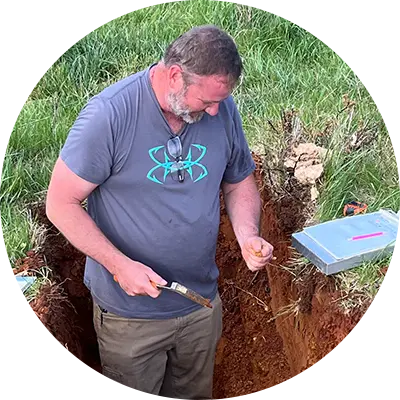
The percolation test is a field procedure conducted in the soil horizon(s) selected for installation of the
proposed subsurface soil absorption system for the purpose of observing the rate that clean water will permeate
the soil under saturated conditions. The test provides a method for approximating the actual movement of
wastewater through the soil which will occur during operation of the subsurface soil absorption system.
Household septic tanks should be pumped every three to five years. Why?
- To prevent too much sludge from accumulating in the tank, which prevents settling before sewage flows to the drainfield.
- To maximize the life of the septic tank.
- To prevent the discovery of a septic system failure by the experience of untreated sewage backing up into the house.
A COSS is defined as “a treatment works system consisting of one or more septic tanks with gravity, pumped, or siphoned conveyance to a gravity sub surface drainfield.” A typical COSS in Virginia consist of a sewer line, a septic tank, a conveyance line, a distribution box, header lines, and multiple absorption trenches. In most cases these components are not visible from the surface. If the COSS requires a pump you may notice a riser typically 24 inches in diameter and roughly 12 inches above the ground surface. An AOSS is defined as “a treatment works system that is not a conventional onsite sewage system and does not result in a point source discharge.” A typical AODD in Virginia consist of a sewer line, septic tank/trash tank, treatment unit, pump chamber, conveyance line, distribution system, and absorption field (trenches, pad, drip tubing, etc.). However, the exact set of components that make up your system will be site specific. These specific components are covered in your Operation and Maintenance Manual (O&M Manual). Alternative onsite sewage systems typically, but not always, have multiple components visible from the ground surface. If you have questions about the AOSS serving your property, you may contact the designer of the system, a licensed alternative onsite sewage system operator or the local health department. Direct discharge systems require a VPDES permit from DEQ, and typically discharge directly from the treatment unit to a dry ditch or stream. Operation and maintenance of direct discharge systems are covered under separate regulations.
Records on file with the local health department indicate that you are the owner of a property served by an Alternative Onsite Sewage System (AOSS). The letter was meant to provide you with information regarding owner responsibilities and proper operation and maintenance of your AOSS under the Regulations for Alternative Onsite Sewage Systems (12 VAC 5-613-20 et. Seq.: the AOSS Regulations).
The best place to find information concerning your particular AOSS is your O&M Manual. Your O&W Manual should be written to be easily understood by any potential owner and should include: 1. Basic information on the AOSS design including treatment unit capacity, installation depth, pump operating conditions, a list of the components comprising the AOSS, a dimensioned site layout, sampling locations, and contact information for replacement parts for each unit process: 2. A list of any control functions and how to use them; 3. All operation, maintenance, sampling, and inspection schedules for the AOSS, including any requirements that exceed the minimum requirements of the AOSS Regulations; 4. The performance (laboratory) data sampling and reporting schedule; 5. The limits of the AOSS design and how to operate the system within those design limits; 6. Other information deemed necessary or appropriate by the designer. If you have not already received a copy of your O&M Manual, or have lost the original, a copy can be attained by contacting the designer of the system, a licensed alternative onsite sewage system operator or the local health department.